Construction & Building Create in CertBox

Risk Assessment & Method Statement (RAMS)

A Risk Assessment and Method Statement — universally known as RAMS — is the combined document that identifies the hazards associated with a piece of work, scores and controls the risks, and then sets out the sequence of operations (the method statement) that operatives must follow. Most principal contractors and clients require RAMS before any work begins on a commercial or public-sector site.

Health and Safety at Work Act 1974, Management of Health and Safety at Work Regulations 1999 (Regulation 3), CDM 2015Valid: Per project (must be reviewed if site conditions, scope, or personnel change)

No credit card required. Set up in 30 seconds.

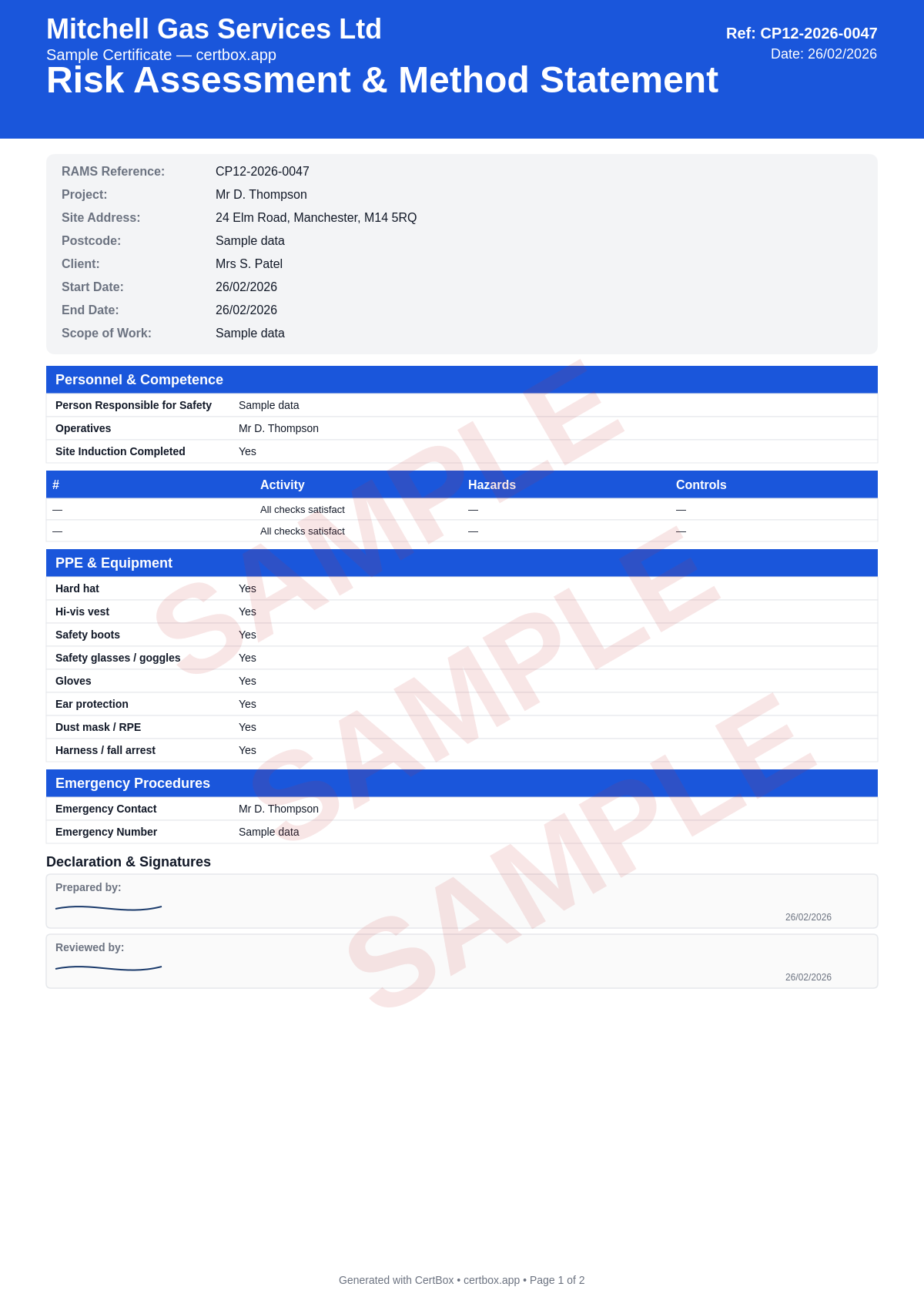
Sample RAMS certificate

Sample Risk Assessment & Method Statement (RAMS) certificate created with CertBox, showing the professional PDF layout with project details: site address, client, scope of work, and dates, personnel and competence: operatives, qualifications, site induction status, hazard identification with likelihood and severity scoring (initial and residual risk)

Sample RAMS with fictional data. All personal details shown are fake.

What it covers

  • Project details: site address, client, scope of work, and dates
  • Personnel and competence: operatives, qualifications, site induction status
  • Hazard identification with likelihood and severity scoring (initial and residual risk)
  • Control measures for each identified hazard
  • Method statement: step-by-step sequence of operations
  • PPE requirements checklist
  • Emergency procedures: nearest A&E, emergency contacts, fire assembly point
  • Declaration and signatures from the person responsible for safety

Who needs a RAMS?

Sole traders working on commercial sites
Sub-contractors working under a principal contractor
Principal contractors compiling site safety documentation
Any tradesman whose client requires RAMS before works commence

Create your RAMS with CertBox

1

Fill in the form

Pick RAMS from the list, fill in the fields on your phone.

2

Compliance checks run

Built-in validation catches missing fields and out-of-range readings.

3

PDF generated instantly

Professional PDF ready to share via secure link or download.

Frequently asked questions about RAMS

What is a RAMS document?
RAMS stands for Risk Assessment and Method Statement. It is a single document that covers two things: the risk assessment (identifying hazards, who is at risk, and what controls are in place) and the method statement (the step-by-step sequence of how the work will be carried out safely). Most commercial and public-sector clients require RAMS before works can start on site.
Is a RAMS document a legal requirement?
Regulation 3 of the Management of Health and Safety at Work Regulations 1999 requires every employer and self-employed person to carry out a suitable and sufficient risk assessment. The method statement is not separately mandated by law but is standard practice under CDM 2015 for construction work, and is almost always a contractual requirement for commercial jobs.
Who needs to produce a RAMS?
Any tradesman, contractor, or self-employed person carrying out work where there are significant hazards. In practice, if you work on commercial sites, housing association properties, schools, hospitals, or for a principal contractor, you will be asked for RAMS before you are allowed to start work — regardless of trade.
Does a sole trader need to do a RAMS?
Yes, if you carry out work with significant hazards or if your client or principal contractor requires it. The Health and Safety at Work Act 1974 and the Management of Health and Safety at Work Regulations 1999 apply to self-employed people. In practice, most commercial clients will not let a sole trader start work without a signed RAMS on file.
How specific does a RAMS need to be?
The HSE requires risk assessments to be "suitable and sufficient" — which means specific to the actual work and site, not a generic template. Hazard descriptions, control measures, and method steps must reflect the real scope of work. A generic boilerplate RAMS is unlikely to satisfy a principal contractor or pass an HSE inspection.
How often should a RAMS be reviewed?
A RAMS must be reviewed and updated if there is a significant change in the work, the site conditions, the personnel involved, or if an incident or near-miss occurs. The declaration section of the document should record the date of preparation and any subsequent review dates.

Ready to create your RAMS?

Free forever. Set up in 30 seconds, no card required.

No credit cardCancel anytimeSet up in 30 seconds

Create your RAMS in minutes