Refrigerant Charge Verification Certificate
A Refrigerant Charge Verification Certificate documents a technician’s check of an air conditioning or heat pump system’s refrigerant charge using the manufacturer-specified method — subcooling for TXV/EXV metering devices, superheat for fixed-orifice systems. It records ambient test conditions, pressure and temperature readings, and whether the charge is within the manufacturer’s target range.
Sample Charge Verification certificate
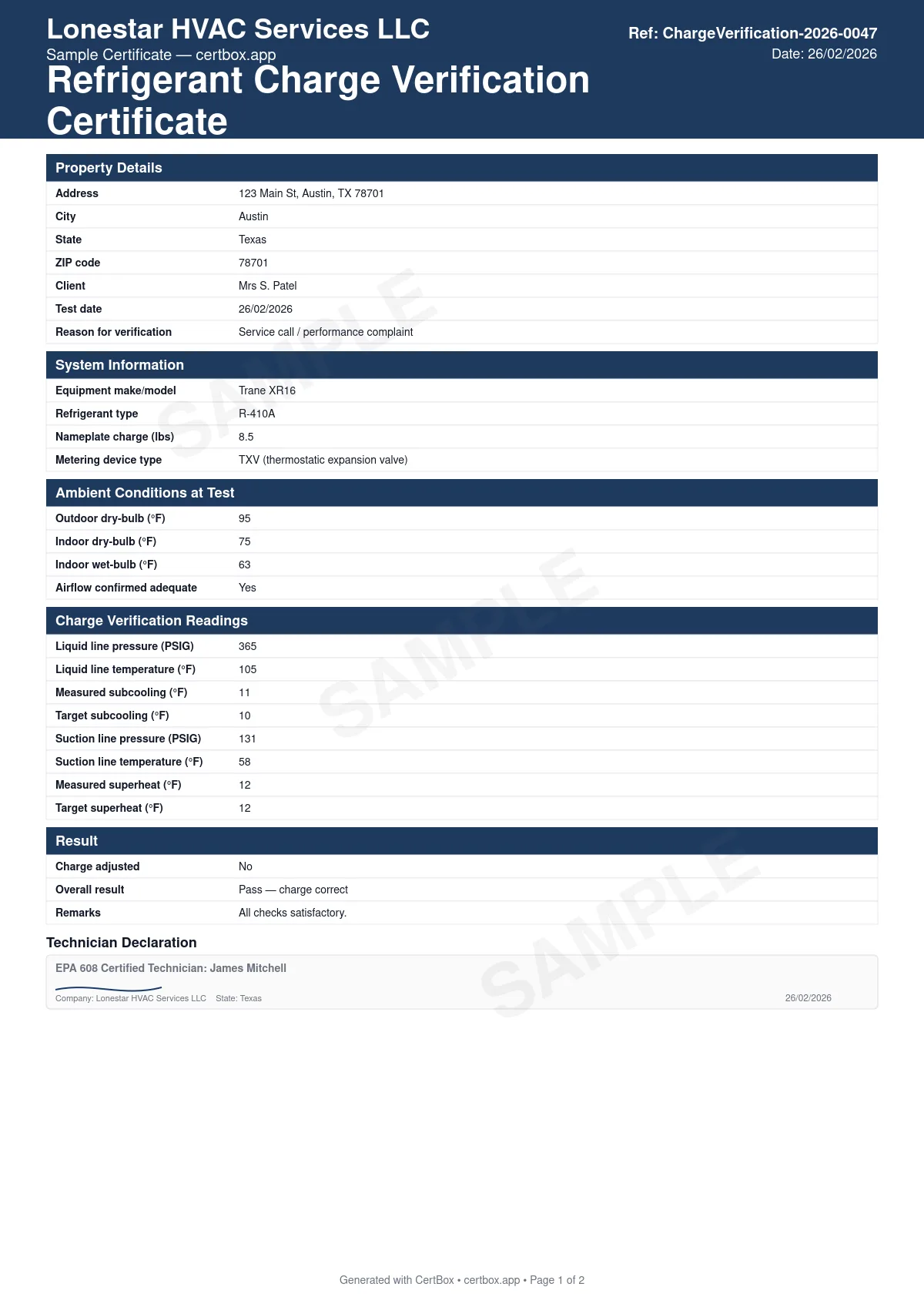
Sample Charge Verification with fictional data. All personal details shown are fake.
What it covers
- Refrigerant type and metering device (TXV vs. fixed orifice)
- Ambient dry-bulb/wet-bulb conditions at test
- Liquid/suction line pressure and temperature readings
- Measured vs. target subcooling or superheat
- Charge adjustment (added/recovered) and overall result
Who needs a Charge Verification?
Create your Charge Verification with CertBox
Fill in the form
Pick Charge Verification from the list, fill in the fields on your phone.
Compliance checks run
Built-in validation catches missing fields and out-of-range readings.
PDF generated instantly
Professional PDF ready to share via secure link or download.
Frequently asked questions about Charge Verification
Subcooling or superheat — which method should I use?
Why do ambient conditions matter for this test?
Learn more
Related certificates
HVAC Commissioning
Create HVAC commissioning certificates on your phone. Document refrigerant charge, airflow, and performance readings. IMC compliant. PDF in minutes.
HVAC TechniciansRefrigerant Log
Create EPA 608 refrigerant recovery logs on your phone. Document recovery amounts, equipment, and disposal per Clean Air Act requirements.
HVAC TechniciansRefrigerant Leak Inspection
Create EPA 608/AIM Act refrigerant leak inspection reports on your phone. Document leak rate, thresholds, and repair status for 50+ lb systems.