Gas Engineers Create in CertBox

Domestic Gas Testing & Purging Record

Your first certificate is free. Then £4.99 each, or £14.99 a month for as many as you like.

Sample Gas Testing & Purging certificate
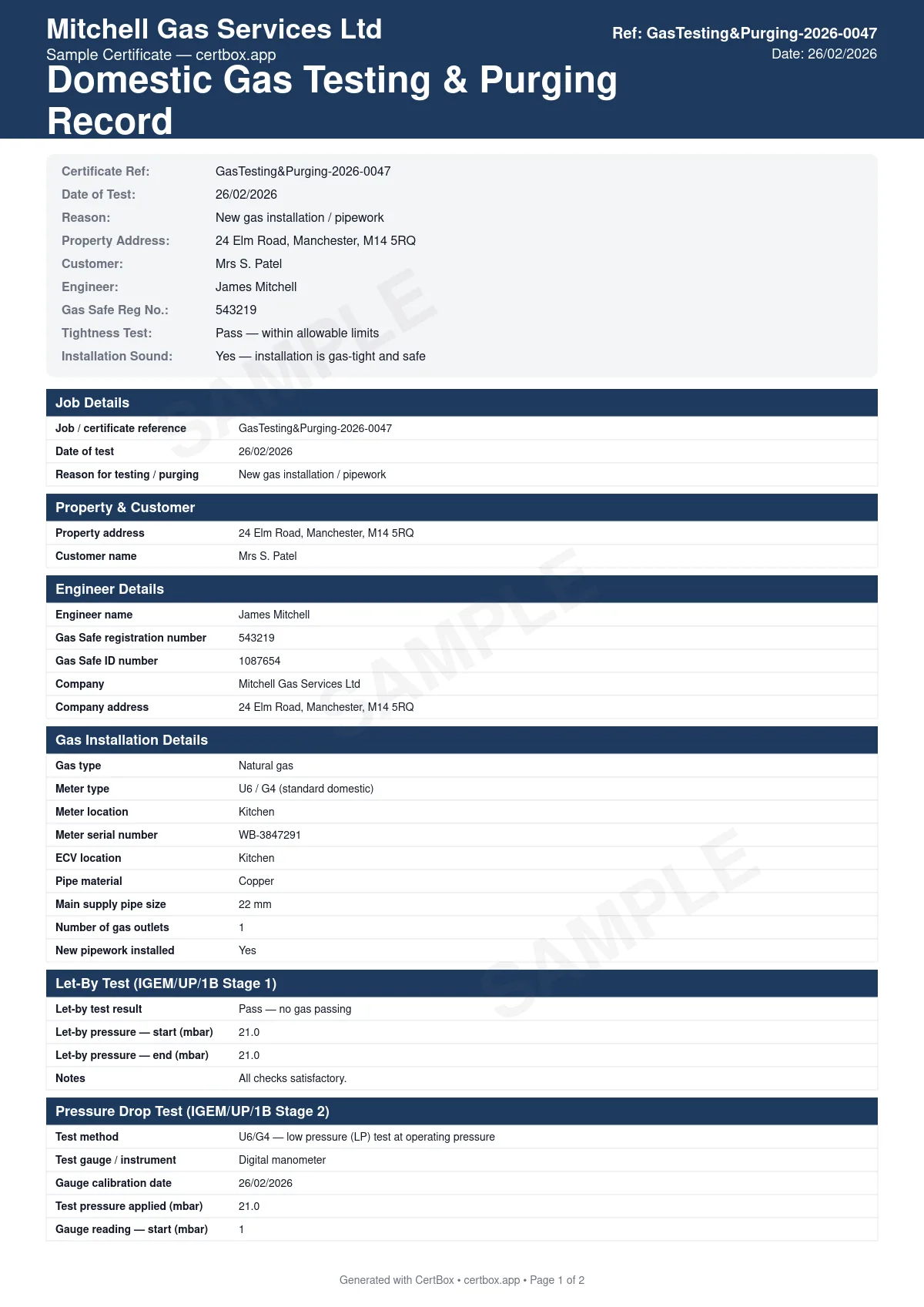
Sample Domestic Gas Testing & Purging Record certificate created with CertBox, showing the professional PDF layout with meter type and location, emergency control valve (ecv) location, let-by test result

Sample Gas Testing & Purging with fictional data. All personal details shown are fake.

A Domestic Gas Testing & Purging Record documents the tightness testing and purging of domestic gas installations. It is used when installing new gas pipework, after modifications to existing pipework, or following repairs. The record covers let-by testing, tightness testing with gauge readings, and purging at each appliance in accordance with BS 6891 and IGEM/UP/1B.

BS 6891, IGEM/UP/1B, Gas Safety (Installation and Use) Regulations 1998Valid: N/A (one-off record per test)

What it covers

  • Meter type and location
  • Emergency control valve (ECV) location
  • Let-by test result
  • Tightness test with pressure gauge readings (start, end, duration)
  • Pressure drop calculation
  • Installation volume, permissible drop and the pipework-only retest
  • Purge volume and purging at each appliance outlet

Who needs a Gas Testing & Purging?

Gas Safe registered engineers
Homeowners (as proof of safe installation)
Landlords
Building Control

Create your Gas Testing & Purging with CertBox

1

Fill in the form

Pick Gas Testing & Purging from the list, fill in the fields on your phone.

2

Send the PDF

Download it, email it to your customer or share a link. Your first one is free to send.

Frequently asked questions about Gas Testing & Purging

When is a tightness test required?
Regulation 22 of the Gas Safety (Installation and Use) Regulations 1998 requires a tightness test straight after any work on a gas fitting that might affect the tightness of the installation, such as new pipework, alterations, or disconnecting and reconnecting pipework. The annual landlord gas safety check does not legally require one, because it covers appliances and flues rather than installation pipework, but HSE and Gas Safe Register recommend testing the whole system at the same visit.
Do I have to work out the installation volume every time?
For the tightness test, only when the gauge drops by more than the smallest permissible limit for the gas, which is 1 mbar on natural gas. That is the answer in the IGEM/UP/1B Edition 4 FAQ. For purging, yes: Gas Safe Register says the purge volume for every installation covered by the standard is 1.5 times the installation volume.
What is the difference between a let-by test and a tightness test?
A let-by test checks that the meter and ECV are not passing gas when in the off position. A tightness test checks the integrity of the pipework downstream of the meter by pressurising the system and monitoring for pressure drop.
What pressure drop is acceptable?
Under IGEM/UP/1B Edition 4, the only edition from 1 October 2026, pipework on its own or with only new appliances connected must show no perceptible movement. With existing appliances connected, any drop is checked against the permissible limit for the gas type and installation volume; meter size no longer sets it. Within the limit, the appliances are isolated and the pipework retested on its own, where any perceptible movement is a fail. Over the limit, the escape must be found and repaired or the installation made safe.

Ready to create your Gas Testing & Purging?

Your first certificate is free. Then £4.99 each, or £14.99 a month for as many as you like.

No card to sign upSet up in 30 seconds

First certificate free